

Your Hearing, Our Priority - Expert Care Tailored Just For You
We believe that exceptional hearing care begins with truly listening to you. We have a dedicated Audiologist with one simple mission: to provide you with the time, care, and expertise you deserve.
Whether you’re curious about your hearing health or facing a specific concern, we will guide you with thorough, clear advice every step of the way.
Because at the heart of what we do is a deep belief: your hearing matters, and so do you.
Frequently Asked Questions
-
Our screening test is free of charge and covers a basic health check of your ears.
If you want or need a full advanced hearing test this is £60 and includes extra health checks such as Tympanometry that checks for any infection of the middle ear.
If you are unsure about what you need, we recommend the screening test first.
-
From just £7 a month, buckle up for a wild ride of benefits! 🎢 You'll snag a yearly private hearing health check to keep those ears sharp as a tack. Oh, and we're pulling out all the stops with our advanced eye test, complete with fancy eye health scans to keep your peepers and listeners in top-notch condition.
And that's not all! You'll groove to a sweet discount off all hearing aids and snazzy eyewear. It's like having your own personal squad of eye and ear guardians, ready to keep you in top form!
Plus, we're throwing in accidental damage cover for those oopsie-daisy moments and free earwax removal when things get a bit too waxy. It's like having a VIP pass to a show where your eyes and ears are the headlining stars!
Ready for more eye and ear magical adventures? Just say the word, and we'll keep the fun rolling! ⚡👁️👂
-
The standard hearing screening test includes a review of your medical history, a physical examination of your ears and a series of hearing tests conducted by our certified audiologist. This is the one we recommend for everyone to start with.
The advanced test includes more in-depth testing and extra diagnostic health checks such as tympanometry.
-
The standard hearing screening test typically takes about 30 minutes.
If this shows any further checks are needed, we usually recommend a full advanced hearing test which can take up to 1 hour.
-
Not at all. The hearing test is completely painless and non-invasive. It involves listening to various sounds through headphones and answering some questions about your hearing experience.
-
Absolutely not. The hearing test is offered with no obligation to purchase any products or services. Our goal is to provide you with a comprehensive screening assessment of your hearing health and to offer recommendations based on your specific needs.
If you do need a hearing aid, we can give you a free trial if you wish but there is certainly no sales talk. We hate that stuff and cringe!
You can purchase hearing aids from any other supplier, not just the place of your hearing test.

Do You Have Real Hearing Loss or Just Earwax?!
Poking around in there with a cotton bud won’t answer that question - and it’s not a good idea anyway!
Your troubles might just be due to build-up of earwax, which can easily be fixed…
We provide a painless, safe earwax removal treatment, offering ample time for a thorough assessment and the gentle, effective removal of earwax.
Don’t let earwax buildup hold you back from enjoying life’s little sounds. Improve the way you hear in less than 30 minutes!
Call us today to book your appointment.
How Do We Hear?
What is sound and how do we hear it? Sound is an animation of waves traveling through the air and reaching the ear. The sound is then transmitted and amplified through the ear, and sent to the brain.
What happens next? A special area of the brain then translates the electrical signals into recognizable and meaningful sounds. When speech and noise arrive together, the brain separates them and allows us to focus on the speech we want to hear.
Let's break down the hearing process using the image below:
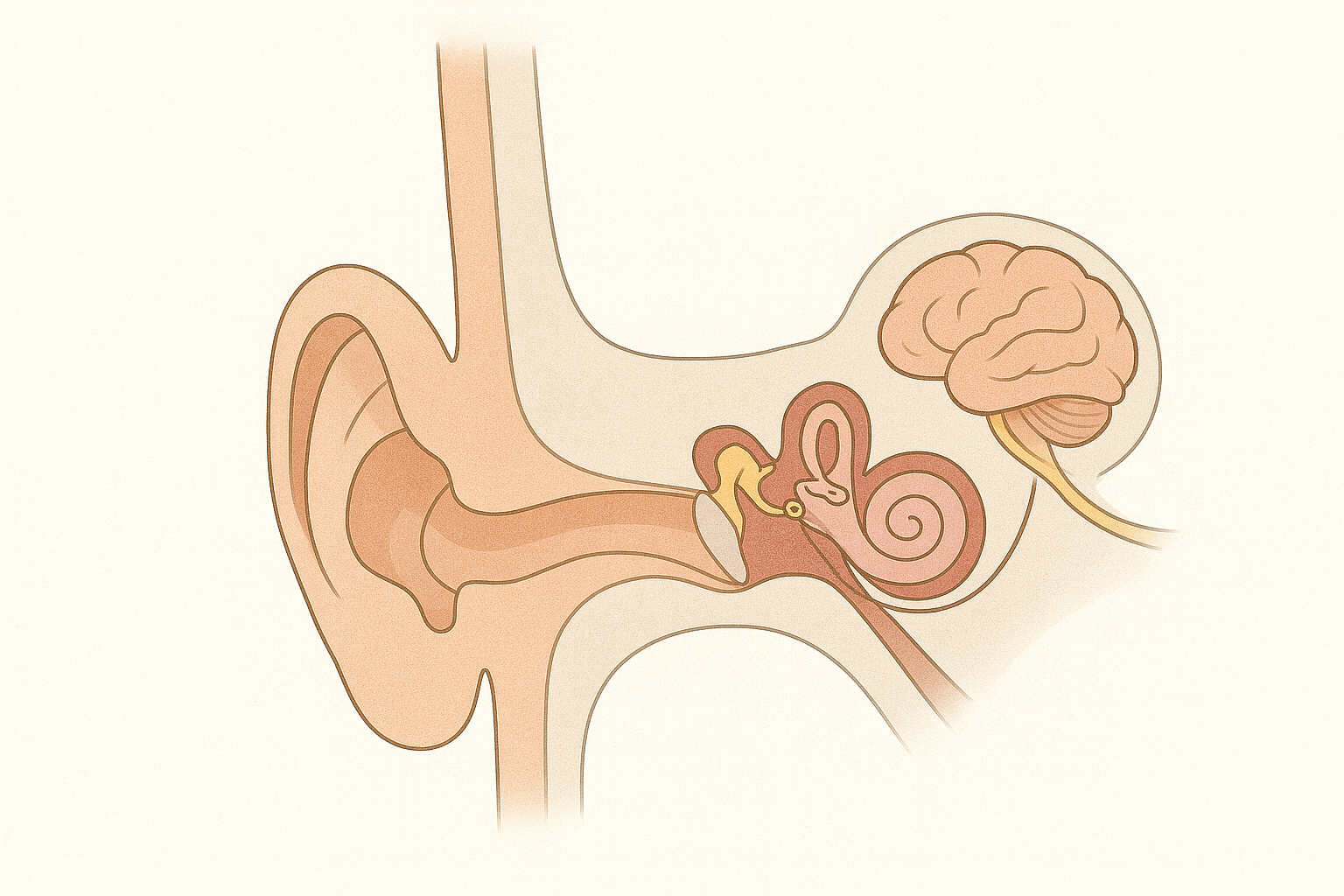
Outer Ear
The first point of contact with sound is the outer ear, which includes the auricle and ear canal and whose purpose is to capture the sound waves.
Ear-Drum
The vibrations in the ear canal reach the eardrum and cause it to vibrate.
Middle Ear
The middle ear transmits and amplifies sound vibrations through 3 tiny bones, the smallest in our body.
Inner Ear
The sound reaches the inner ear, which converts the acoustic vibrations into an electrical signal.
Brain
The electrical signals travel along the auditory nerve until they reach the brain.
Hearing and Well-Being
Hearing is one of the most important senses for functioning in everyday life. Here are the main reasons that make it indispensable to us:
-
From classroom discussions to listening to instructions, hearing facilitates learning and development throughout life.
-
Many jobs require good hearing for safety, communication, and efficiency.
-
Participating in social activities, enjoying entertainment, and experiencing the environment often depends on our ability to hear.
-
Hearing alerts us to potential dangers such as approaching vehicles, alarms, or cries for help.
Beyond Function: The Joy of Hearing
All of these previously mentioned functions are not the only reasons for the importance of this essential sense. Hearing helps us get the most out of life in many other situations, such as:
-
Conversations and shared experiences that require hearing create strong personal bonds.
-
Hearing allows us to appreciate music, performances, and the nuanced sounds in our environment.
-
The sounds of nature, such as birds chirping, water flowing, and leaves rustling, provide a sense of peace and connection to the environment.
-
Everyday sounds, such as a baby's laugh or a loved one's voice, are irreplaceable joys of life.
Understanding Hearing Loss
Now that we have learned about hearing, we need to focus on hearing loss, a reduced ability to hear sounds, either partially or not at all.
It's important to note that unlike vision loss, where you can't see clearly from a certain distance, hearing loss causes you to miss some sounds even at comfortable levels. This can cause people to misunderstand what is being said to them and to switch between similar-sounding words such as "sink" and "think" or "seed" and "sit".
People with mild hearing loss usually don't feel that their ears are completely blocked or that they can't hear anything. Instead, they may perceive their hearing as normal, but occasionally miss certain words.

Hear Loss Prevalence.
Hearing loss is a common condition that affects millions of people around the world, and the risk of suffering from hearing loss increases with age.
Taking data from the US:
50%
People 75 and over are hearing impaired.
24%
People between 65 and 74 are hearing impaired.
14%
People between 41 and 59 are hearing impaired.
While hearing loss is a common sensory impairment, it's important to recognise that its prevalence is comparable to, and in some cases higher than, other well-known conditions such as diabetes and vision impairment.
Despite its widespread impact, hearing loss is often underdiagnosed and undertreated, underscoring the need for increased awareness and access to hearing healthcare.
Contact us.
-
24 Zetland Road,
Loftus,
TS13 4PWcontactus@loftusoptical.co.uk
Opening Hours
Monday to Friday 9 am to 5 pm by appointment only.
-
107 High Street,
Skelton,
TS12 2DYcontactus@skeltonoptical.co.uk
Opening Hours
Monday to Friday 9 am to 5 pm by appointment only.